2023 06 23
Table of Contents:
GS Paper 2:
- State Election Commission (SEC)
- Global Gender Gap Report 2023
GS Paper 3:
- Issues with the climate finance mechanisms
- Organic and natural farming in India
Content for Mains Enrichment
- Brand Bengaluru
- Sylvester daCunha
Facts for Prelims (FFP)
- Biden Yeats’ ‘Ten Principal Upanishads’
- Ambedkar’s London house
- Lab Grown Diamond
- Treating Wastewater
- Gangotri National Park (GNP)
Mapping
- Kalasa Banduri project (Mahadayi River, Goa)
State Election Commission (SEC)
GS Paper 2
Syllabus: Constitutional Bodies
Source: TH
Context: West Bengal Governor C.V. Ananda Bose holds the State Election Commission (SEC) accountable for the violence occurring during the ongoing panchayat poll process in the state.
Recent tussle between West Bengal CM and Governor:
- The Governor’s recent actions, including returning the joining report of SEC Rajiva Sinha, have triggered a constitutional crisis.
- Chief Minister Mamata Banerjee ruled out the possibility of removing the SEC and emphasized the peaceful nature of the elections.
- Last year, then-governor Jagdeep Dhankhar was accused of delaying bills and interfering in matters of administration by the West Bengal Government.
- Also, Bengal passed a Bill replacing Governor with CM as state university Chancellor
About State Election Commissions (SECs):
| Description | |
| About | The SEC is responsible for conducting free, fair, and impartial elections to the local bodies within a state. |
| Appointment of SECs | Appointed by the Governor. |
| Powers: Article 243K(1) | It vests the superintendence, direction, and control of the preparation of electoral rolls and the conduct of elections to Panchayats (Municipalities under Article 243ZA) in the State Election Commission, headed by a State Election Commissioner appointed by the Governor. |
| Tenure: Article 243K(2) | It states that the tenure and appointment of the State Election Commissioner will be directed by the law made by the state legislature. |
| Removal | The State Election Commissioner has the status, salary and allowance of a Judge of a High Court and cannot be removed from office except in like manner and on the like grounds as a Judge of a High Court. |
Issues with SECs:
| Examples | |
| Violence during elections | E.g., West Bengal Governor blames SEC for violence during recent panchayat polls |
| State government interference | This is despite the fact that under the constitutional mandate, it is the duty of the State to not interfere with the functioning of the State Election Commission |
| Lack of impartiality and Questionable accountability | Often SECs have been found to be hand in glove with the state government. |
| Appointment of serving bureaucrats | In this regard, SC has observed that This is necessary because giving government employees the additional charge of State Election Commissioners is a “mockery of the Constitution”. |
| Challenges to independence | Tenure and appointment of the State Election Commissioner are directed by the law made by the state legislature. |
| Conflicts with state government | In Maharashtra (2008), then-state election commissioner Nand Lal was arrested and sent to jail for two days in March 2008 after the Assembly found him guilty of breach of privilege in an alleged conflict over his jurisdiction and powers. |
Suggestions for Reforms in SECs:
| Supreme Court | The Supreme Court in 2021 ruled that serving bureaucrats must not be appointed as election commissioners to ensure that the independence of the office of the election commissioner is not compromised. |
| 2nd ARC | The 2nd ARC suggests that the State Election Commissioner should be appointed by the Governor based on the recommendation of a collegium comprising the Chief Minister, the Speaker of the State Legislative Assembly, and the Leader of the Opposition in the Legislative Assembly. |
| 2nd ARC proposes the establishment of an institutional mechanism to facilitate the coordination, sharing of experiences, and resources between the Election Commission of India and the State Election Commissions. | |
| Law Commission 255th Report on Electoral Reforms | The report recommends adding a new sub-clause to Article 324 of the Constitution to establish a separate, independent, and permanent Secretariat for the Election Commission of India, similar to the Lok Sabha/Rajya Sabha Secretariats under Article 98. Similar provisions can be made for the State Election Commissions to ensure autonomy and fair local body elections. |
Insta Links:
Mains Link:
Are the State Election Commissions in India as independent as the Election Commission of India? Discuss. (250 Words)
June 23, 2023 /23 June 2023, Today's Article
Global Gender Gap Report 2023
GS Paper 2
Syllabus: Issues Relating to Development and Management of Social Sector
Source: ET
Context: According to the annual Gender Gap Report 2023 (17th edition) of the World Economic Forum (WEF), India was ranked 127 out of 146 countries in terms of gender parity – an improvement of 8 places from last year.
The Global Gender Gap Report:

- It is an annual index first published in 2006 by the WEF to measure gender equality.
- It assesses countries on how well they are dividing their resources and opportunities among their male and female populations, regardless of the overall levels of these resources and opportunities.
- It serves as a catalyst for greater awareness as well as greater exchange between policymakers.
Highlights of the 2023 report:

- No country has yet achieved full gender parity.
- For the 14th consecutive year, Iceland (91.2%) takes the top position. It also continues to be the only country to have closed more than 90% of its gender gap.
- Gender parity in Europe (76.3%) surpasses the parity level in North America (75%) this year to rank first of eight geographic regions.
- Sub-Saharan Africa ranks 6th (68.2%), slightly below the global weighted average score (68.3%).
- Southern Asia (63.4%) overtakes the Middle East and North Africa (62.6%) – the region furthest away from parity in 2023.
Major challenge:
- The state of gender parity in the labour market remains a major challenge.
- Not only has women’s participation in the labour market globally slipped, but other markers of economic opportunity have been showing substantive disparities between women and men.
- For example,
- Labour markets of the future: Women remain significantly underrepresented (29.2%) in the STEM workforce.
- Skills of the future: Women do not have equal opportunities and access to online learning platforms, given the persistent digital divide.
Performance of India:
- The country had improved by 1.4 percentage points and 8 positions since the last edition and had closed 64.3% of the overall gender gap.
- The country had attained parity in enrolment across all levels of education.
- On political empowerment, India has registered 25.3% parity, with women representing 15.1% of parliamentarians – the highest for the country since the inaugural report in 2006.
- This comes after the WEF recognised the need to enumerate women’s participation in local government bodies in its Gender Gap Report after the Indian government raised the issue.
Performance of India’s neighbours: Pakistan at 142, Bangladesh at 59, China at 107, Nepal at 116, Sri Lanka at 115 and Bhutan at 103.
Challenges for India:
- India had reached only 36.7% parity in economic participation and opportunity.
- While there had been an uptick in parity in wages and income, the share of women in senior positions and technical roles had dropped slightly since the last edition.
- The relatively low overall rankings on the Health and Survival sub-index are explained by skewed sex ratios at birth.
Way ahead:
- Implementing a Diversity, Equity and Inclusion (DEI) programme.
- Increasing women’s economic participation and achieving gender parity in leadership (both business and government).
- Collective, coordinated and bold action by private and public sector leaders will be instrumental in accelerating progress towards gender parity.
Conclusion:
The gender parity globally has recovered to pre-Covid levels but the pace of change has stagnated as converging crises slow progress.
Insta Links:
Mains Links:
Discuss the desirability of greater representation to women in the higher judiciary to ensure diversity, equity and inclusiveness. (UPSC 2021)
June 23, 2023 /23 June 2023, 23 June CA, Diversity Equity and Inclusion (DEI) programme, Global Gender Gap Report 2023, GS 2, Today's Article, Today’s article, WEF
Issues with the climate finance mechanisms
GS Paper 2
Syllabus: Effect of Policies and Politics of Developed and Developing Countries on India’s Interests
Source: IE
Context: The industrialised countries have not walked the talk of financing the climate mitigation and adaptation efforts of the poorer countries.
Why does the burden lie on industrialised countries? Historical responsibility
- A bulk of the accumulated GHGs, the reason for global warming, have come from a group of about 40 rich and industrialised countries, usually referred to as Annex I countries in the 1992 UNFCCC.
- The contribution of the poorer countries (the Global South) was negligible.
- Additionally, countries in the Global South were already struggling to pay their external debt, exacerbated by the pandemic.
Mechanisms that made industrialised countries liable:
- The Kyoto Protocol (1997) recognised the “common but differentiated responsibilities” in the fight against climate change.
- The Paris Agreement (2015) asked countries to set voluntary emission targets but required the richer countries to make financial transfers to the developing economies.
- It set a floor of $100 billion per year (that the developed countries had committed to raising from 2020) for these transfers.
Concerns:
- In the definition of climate finance, commercial loans should not be counted.
- In 2020, $83 billion was paid into the climate finance fund to be transferred to the countries of the Global South.
- Out of this, less than $25 billion was in the form of grants.
Recent efforts to boost climate finance:
- New Global Financing Pact
- The EU has put forward a proposal, called the Carbon Border Adjustment Mechanism (CBAM).
CBAM:
- This involves imposing tariffs on imports from other countries that are seen to be using carbon-intensive methods of production.
- This mechanism, starting in 2026, will cover products such as cement, steel, aluminium, oil refinery, paper, glass, chemicals and electricity generation.
The CBAM is expected to achieve three objectives: Reduce the EU’s emissions, for the EU not lose competitiveness in carbon-intensive goods and to make the targeted countries reduce the carbon intensity of their exports.
Issues with CBAM:
- The CBAM is a unilateral move, against the spirit of multilateralism.
- It could be used for protectionism.
- Equity considerations, are designed to help rich countries avoid paying for creating the climate problem.
- It targets production processes (not the product itself) that the WTO does not approve of.
How will it affect the Global South? This mechanism seeks to penalise “free riders” – one who is not contributing, although has the means to do so.
Most affected:
- Only 3 of the 12 exporters to the EU have a mechanism for “pricing carbon”.
- The countries most affected will be Russia, Ukraine, Turkey, India and China.
Way ahead:
- A global price for carbon to redress the global “externality”.
- Clarity on the following before CBAM is implemented:
- First, which countries will be exempt? These are likely to be those that possibly have a national emissions cap or a sectoral cap or are the poorest countries.
- Second, which emissions are included in the levying of the import tax?
- Finally, which products are to be included? Possibly, a narrow coverage with high trade and carbon exposure.
Insta Links:
The Bonn climate change conference
June 23, 2023 /23 June 2023, 23 June CA, CBAM, Climate Finance., GS 2, kyoto protocol, New Global Financing Pact, Paris Agreement., Today's Article, Today’s article
Organic and natural farming in India
GS Paper 3
Syllabus: Agriculture and related issues
Source: DTE
Context: According to a CSE report, market access is critical for the success of India’s momentum towards organic and natural farming, which are good for the farmer, nature and human health.
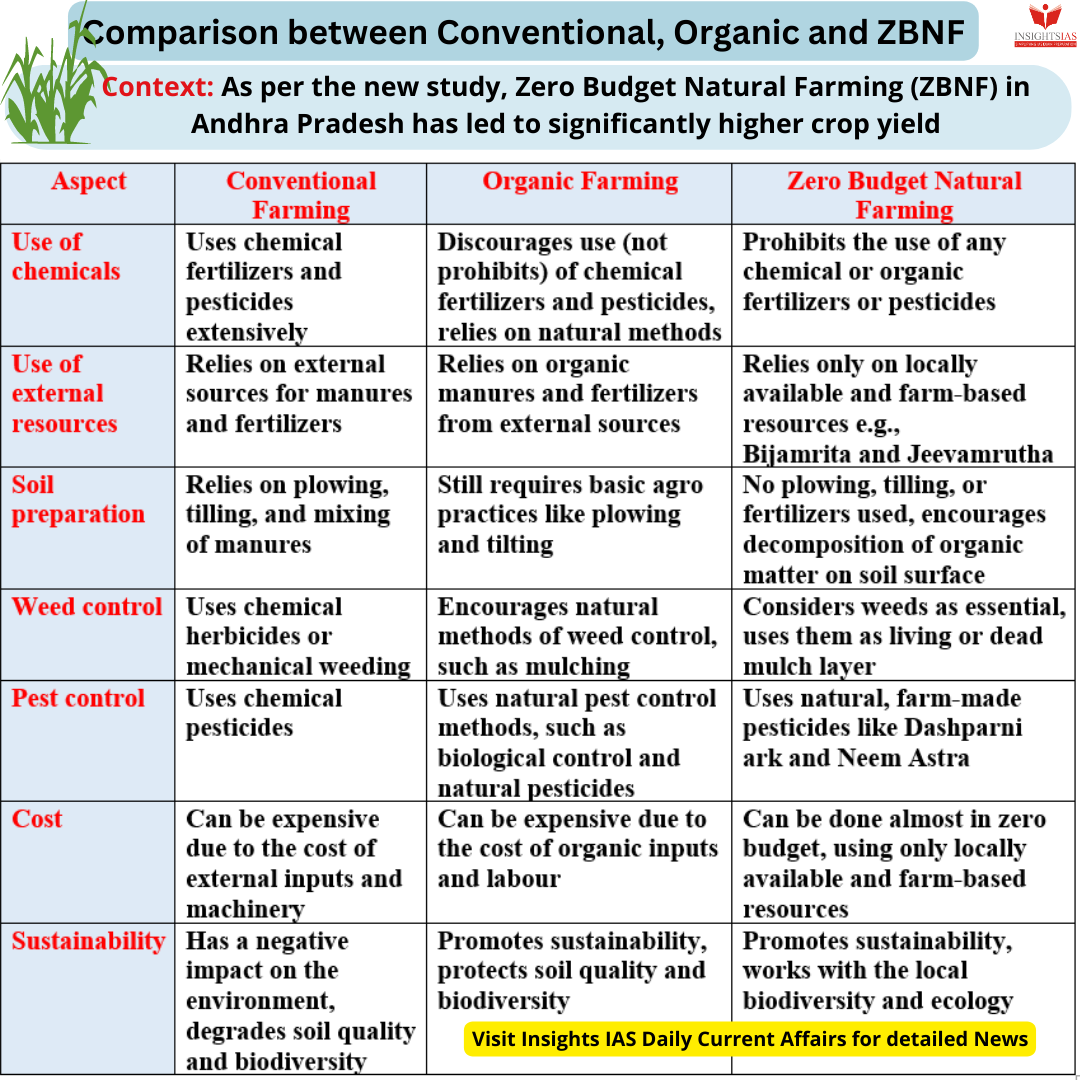
About the CSE report: The report highlights how various stakeholders procure, process and sell organic and natural produce while trying to ensure remunerative prices to farmers.
Challenges faced by farmers:
- Lack of market access → unable to sell their produce at a remunerative price.
- Lack of certification → detrimental to demands (domestic and exports) → becoming a barrier in India’s journey towards non-chemical farming practices.
- Organic farmers don’t get all the benefits conventional farmers get in terms of subsidies.
Way ahead:
- Working with consumers for behavioural change towards organic produce (as in the case of millet).
- Coherence in the different certification systems like Participatory Guarantee System (PGS) and third-party National Programme for Organic Production (NPOP) certification.
- Farmer Producer Organisations (FPOs) need government support for working capital, dedicated infrastructure and support for capacity building.
- Expand value addition and move towards shorter supply chains for better price realisation by farmers.
Some best practices from Himachal Pradesh:
- Prakritak Kheti Khushhal Kisan Yojana: To increase agricultural income by adopting ZBNF. The system will not only improve soil fertility but also discourage the use of fertilisers and pesticides and reduce environmental pollution.
- Subsidy: To promote organic farming in the state, the state government is providing a 50% subsidy to farmers for setting up vermicompost units.
Conclusion: Unless farmers get assured access to the market to sell their produce at a remunerative price, the challenge of transition will remain difficult to overcome.

Insta Links:
Prelims Links: UPSC 2018
With reference to organic farming in India, consider the following statements:
- The National Programme for Organic Production (NPOP) is operated under the guidelines and directions of the Union Ministry of Rural Development.
- The Agricultural and Processed Food Products Export Development Authority (APEDA), functions as the Secretariat for the implementation of NPOP.
- Sikkim has become India’s first fully organic State.
Which of the statements given above is/are correct?
- 1 and 2 only
- 2 and 3 only
- 3 only
- 1, 2 and 3
Ans: 2
June 23, 2023 /23 June 2023, 23 June CA, GS 3, NPOP, Organic Farming, PGS Scheme, Today's Article, Today’s article, ZBNF
Brand Bengaluru
Content for Mains Enrichment
The Karnataka government has launched an online portal called ‘Brand Bengaluru’ to gather suggestions from the public regarding the development of the city. An expert committee will be formed to create a comprehensive master plan for the city’s development within six months.
Related News:
The Bruhat Bengaluru Mahanagara Palike (BBMP) Restructuring Committee has been reconvened by the Karnataka government with a larger mandate to address the governance and administration challenges faced by the rapidly growing city of Bengaluru.
The committee’s goal is to achieve deep decentralization at the ward level while maintaining appropriate centralization at higher levels of governance. It recommends the establishment of a three-tier governance framework consisting of the Greater Bengaluru Authority, Municipal Corporations, and empowered ward committees.
Usage: The examples can be used in Governance/ ethics questions for citizen participation in governance.
June 23, 2023 /23 June 2023, Brand Bengaluru, Bruhat Bengaluru Mahanagara Palike (BBMP) Restructuring Committee, Today's Article
Sylvester daCunha
Source: NDTV
Sylvester daCunha, the creator of the iconic ‘Amul Girl’ and ‘Utterly Butterly’ campaigns, passed away. Amul paid tribute to him through a creative caricature featuring him and the Amul girl.
Lessons from Sylvester daCunha’s life:
- Creating a memorable and iconic campaign can leave a lasting impact.
- Building trust and respect with clients is crucial for long-term success.
- Creativity and humour can be powerful tools in advertising.
- Embracing topical and relevant content can help connect with consumers.
Usage: The example can be used in an Essay/Ethics on innovation, building trust and the use of humour to connect to people.
June 23, 2023 /23 June 2023, amul, Sylvester daCunha, Today's Article
Biden Yeats’ ‘Ten Principal Upanishads’
Facts for Prelims (FFP)
Source: IE
Context: Prime Minister Narendra Modi gifted US President Joe Biden a first edition print of the book “The Ten Principal Upanishads” (1937) during his visit to the White House.
About the Book:
The book was translated from Sanskrit by Shri Purohit Swami, a scholar of Hindu scripture, and Irish poet WB Yeats. Yeats had a lifelong fascination with Indian philosophy and literature, and his interest in the Upanishads led to the co-translation. The book is considered one of the best translations, aiming to retain the original text’s essence while being accessible to the general reader.
About Hindu Scriptures
| There are broadly two categories of Hindu sacred texts: | |
| Shruti (revealed) | Considered authoritative; Includes the four Vedas (Rig, Yajur, Sama, and Atharva) and accompanying texts; Contains Brahmanas (ritual texts), Aranyakas (“forest” or “wilderness” texts), and Upanishads (philosophical texts) |
| Smriti (to be remembered) | Less authoritative than shruti; Derived from shruti; Includes epics like Ramayana and Mahabharata, Dharmashastras, Puranas, and post-Vedic scriptures |
| What are Upanishads? | The Upanishads (also known as the Vedanta) are important Hindu religious texts that speculate on the connection between the atman, or the distinct, unchanging self of an individual, and the brahman, the ultimate reality in the universe. |
| Ten principals of Upanishads | Esha, Kena, Katha, Prashna, Mundaka, Mandukya, Taittiriya, Aitareya, Chandogya, Brihadaranyaka |
About Yeats
William Butler Yeats (1865-1939) was an Irish poet, dramatist, writer and politician. One of the foremost figures of 20th-century literature, he was a driving force behind the Irish Literary Revival. WB Yeats’ connection to India can be seen through his friendship with Rabindranath Tagore and his earlier poems inspired by India.
Yeats wrote three poems (published in 1889) that referred to India:
- ‘The Indian to His Love’
- ‘The Indian upon God’
- ‘Anushuya and Vijaya’.
June 23, 2023 /23 June 2023, Biden Yeats’ ‘Ten Principal Upanishads’, Today's Article, William Butler Yeats
Ambedkar’s London house
Source: TH
Context: The Maharashtra government in India is planning to grant permission to the central government to assume control of Dr B.R. Ambedkar’s former residence in London, which has been converted into a museum.
- Dr Bhimrao Ramji Ambedkar (1891-1956) lived in the house during 1921-22
More about the News:
The Ministry of External Affairs has expressed its desire to take over the museum and transform it into an autonomous unit. The central government intends to enhance the museum’s operations and establish it as an autonomous unit, with a director appointed by the Indian government.
The director would report to the Director of the Nehru Centre, the cultural wing of the High Commission of India in the United Kingdom. The move aims to promote a broader understanding of Babasaheb Ambedkar’s work and involve Indian students studying in London.
The current maintenance of the property is funded by the Maharashtra government through the High Commission of India. The property was purchased by the Maharashtra government in 2015 to preserve it as a historically important monument.

June 23, 2023 /23 June 2023, Ambedkar’s London house, Today's Article
Lab Grown Diamond
Source: TH
Context: Prime Minister Narendra Modi gifted a 7.5-carat lab-grown diamond to U.S. First Lady Jill Biden during his state visit. The diamond was manufactured in a Surat factory in Gujarat, using a process that replicates the formation of natural diamonds beneath the earth’s surface.
More about the LGD:
- India is a leading player in growing lab-grown diamonds, with exports reaching over $1.67 billion.
- Lab-grown diamonds offer a more affordable alternative to natural diamonds and are considered eco-friendly.
- They are around 20% cheaper than their naturally-formed equivalent
- India is the largest producer of lab-grown diamonds through CVD technology and contributes to nearly 25% of global LGD production through CVD technology.
- But overall, India accounts for 15% of the global production of LGD

CVD Vs HPHT:
CVD technology offers consumers the purest type of diamond. LGDs produced through the HPHT method are grown through a different technique in China and do not have the same hardness as a mined diamond or a CVD-grown diamond and also contain metal impurities.
June 23, 2023 /23 June 2023, lab-grown diamond, Today's Article
Treating Wastewater
Source: DST
Context: Researchers from NIT Warangal and Prime Textiles, with support from IMPRINT, have developed a low-cost and eco-friendly technology to treat textile wastewater.
The technology combines biosurfactants, cavitation, and membrane processes to effectively remove pollutants from the effluent.
| Technology | Description |
| Biosurfactants | Biosurfactants are surface-active compounds produced by microorganisms. In the context of wastewater treatment, biosurfactants are used to aid in the removal of dyes from textile effluent. |
| Cavitation | Cavitation is a process in which pressure variations in a liquid create countless small cavities that rapidly form and implode. In wastewater treatment, cavitation is employed as an advanced oxidation process (AOP) to destroy various types of pollutants. It helps in reducing installation costs and carbon footprint. |
| Membrane Processes | Membrane processes involve the use of selectively permeable membranes to separate contaminants from water or wastewater. In the case of textile effluent treatment, the membrane is modified to decrease pore size and enhance performance. It effectively separates pollutants, resulting in cleaner water. |
Usage: The treated water can be used for agricultural activities and cleaning purposes. The technology offers a sustainable solution for textile effluent, with the potential to replace existing treatment plants due to its affordability and environmental benefits.
About IMPRINT (Impacting Research Innovation and Technology) India
It is a joint initiative (launched in 2015) of the Indian Institutes of Technology (IITs) and the Indian Institute of Science (IISc).
- Aim: It aims to boost research and innovation in ten technology domains relevant to India, such as healthcare, energy, and manufacturing. It further aims to reduce dependence on foreign technology and measure the impact of research efforts on people’s lives.
- Process: The program provides funding and support for research projects to address major engineering and technology challenges.
- Ministry: HRD Ministry
June 23, 2023 /23 June 2023, IMPRINT, Today's Article, Wastewater treatment
Gangotri National Park (GNP)
Source: TOI
Gangotri National Park (GNP) in Uttarakhand, has decided to transfer approximately 50 hectares of land to the Army and Indo-Tibetan Border Police (ITBP) for the development of new bunkers and border outposts near the Line of Actual Control (LAC).
About Gangotri National Park
The park was established in 1989 in Uttarkashi, Uttarakhand. It is located in the upper catchment of the Bhagirathi River and includes Gaumukh at Gangotri Glacier, the source of the river Ganga. The park serves as a connecting link between Govind National Park and Kedarnath Wildlife Sanctuary.

About Indo-Tibetan Border Police
The Indo-Tibetan Border Police (ITBP) (est. 1962; HQ: New Delhi) is a central paramilitary force responsible for border guarding duties along the Sino-India Border, covering a distance of 3,488 km from Karakoram Pass in Ladakh to Jachep La in Arunachal Pradesh. The ITBP is known for its specialization in mountain operations, with its officers and personnel being trained mountaineers and skiers. In November 2019, the Ministry of Home Affairs proposed the merger of the Assam Rifles with the ITBP.
June 23, 2023 /23 June 2023, Gangotri National Park (GNP), Indo-Tibetan Border Police, Today's Article
Kalasa Banduri project (Mahadayi River, Goa)
Mapping
Source: TH
The Kalasa-Banduri project aims to divert water from the Mahadayi River to meet the drinking water needs of several districts in Karnataka. However, the project has faced opposition from the governments of Goa and Maharashtra, who recently issued a joint statement pledging to fight against Karnataka’s water diversion plans.
The Mandovi is a river that originates from springs at Bhimgad in the Western Ghats of Belgaum district in Karnataka. It has its basin in Maharastra and Goa as well. It is described as the lifeline of the Indian state of Goa. Mandovi joins with the Zuari River at a common creek at Cabo Aguada, forming the Mormugao harbour in Goa.

June 23, 2023 /23 June 2023, Kalasa Banduri project, Mandovi River, Today's Article
The Electricity (Rights of Consumers) Rules
GS Paper 3
Syllabus: Infrastructure (Energy)
Source: PIB
Context: The government has amended the Electricity (Rights of Consumers) Rules 2020 to empower power consumers, ensure a 24X7 reliable electricity supply at affordable cost, etc.
The Electricity (Rights of Consumers) Rules 2020:
- The Ministry of Power has promulgated the Rules under the Electricity Act, 2003.
- These rules shall empower the consumers of electricity as the consumers have the right to get reliable services and quality electricity.
Rights and obligations under the Rules:
- It is the duty of every distribution licensee to supply electricity on request made by an owner or occupier of any premises in line with the provisions of the Act.
- It is the right of consumers to have minimum standards of service for the supply of electricity from the distribution licensee.
The changes made in the Rules:
- Introduction of Time of Day (ToD) Tariff, and
- Rationalisation of smart metering provisions.
Introduction of Time of Day (ToD) Tariff:
- Rather than being charged for electricity at the same rate at all times of the day, there will be separate tariffs for peak hours, solar hours and normal hours.
- Tariffs during solar hours (8 hours in a day as specified by the State Electricity Regulatory Commission) shall be 10%-20% less than the normal tariff.
- Tariffs during peak hours will be 10 to 20% higher.
- It shall be made effective immediately after the installation of smart metres, for the consumers without smart metres.
Applicable for:
- Commercial and Industrial consumers have Maximum demand of 10 KW and above, from 1st April 2024 and
- For all other consumers except agricultural consumers, latest from 1st April 2025.
Significance:
- The ToD is a win-win for consumers as well as the power system.
- For consumers:
- The separate tariffs will send price signals to consumers to manage their load according to the Tariff.
- With awareness and effective utilisation of the ToD tariff mechanism, consumers can reduce their electricity bills.
- For the power system: The ToD mechanism will also ensure better grid integration of Renewable Energy sources thereby facilitating faster energy transition for India.
Current status of ToD mechanism:
- In India: Most of the State Electricity Regulatory Commissions (SERCs) have already implemented ToD tariffs for the large Commercial and Industrial category of consumers.
- Various statutory provisions already exist to enable and promote the implementation of ToD tariffs (i.e. Tariff Policy 2016, Electricity Act 2003 and National Electricity Policy 2005).
- Globally: It is recognised across electricity industries, as an important Demand Side Management (DSM) measure to reduce the demand during peak periods.
Amendment in smart metering provision:
- The government has simplified the rules for smart metering.
- To avoid inconvenience/harassment of the consumers, the existing penalties for an increase in consumer demand beyond the maximum sanctioned load/demand have been reduced.
- Post installation of a smart metre, no penal charges will be imposed on a consumer based on the maximum demand recorded by the smart metre for the period before the installation date.
Insta Links:
The Electricity (Rights of Consumers) Rules
Mains Links:
What are the problems being faced by the Power Sector? How can these problems be resolved with the help of the Draft National Electricity Policy 2021? Explain.
June 26, 2023 /23 June 2023, 26 June CA, GS 3, The Electricity (Rights of Consumers) Rules, The Electricity Act 2003, Time of Day (ToD) Tariff, Today's Article, Today’s article
Read the CA in PDF format here:
Follow us on our Official TELEGRAM Channel HERE
Subscribe to Our Official YouTube Channel HERE
Please subscribe to Our podcast channel HERE
Official Facebook Page HERE
Follow our Twitter Account HERE
Follow our Instagram Account HERE
Follow us on LinkedIn: HERE
CategoriesCURRENT AFFAIRS, CURRENT EVENTS, Today's Article